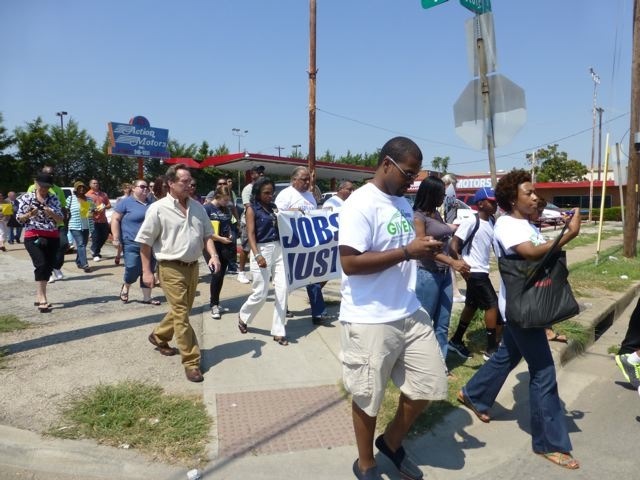
Friday, October 14, 2011


Workers’ Rights Board Members Visit Representative Hensarling’s Office

Last Tuesday Isabel Docampo, Ed Middleton, Annika Rieger, Helen Rieger, and Rosemarie Rieger visited the office of Representative Jeb Hensarling in Congressional District 5. All are constituents of the district and members of the North Texas Jobs with Justice’s Workers’ Rights Board. The group met with District Director Michael Garcia and presented him with the findings of the Board’s past two years of investigations on the economic and jobs crisis. These investigations based on testimony from unemployed and employed workers, worker rights advocates, union organizers, community activists, and others lead to the following conclusions:

-There is no such thing as a jobless recovery.

-Unemployment/underemployment is not a personal problem.

-The wealthy and the corporations are benefitting from this crisis.

-There is something we can do.

Therefore, the group asked District Director Garcia to pass on five items that the Workers’ Rights Board would like to see Representative Hensarling support, namely:

-The creation of good jobs with living wages, green jobs while rebuilding and modernizing America and its infrastructure;

-the implementation of fairer tax rates (such as taxing the wealthy), ending tax breaks for corporations, and introducing a Wall Street speculation tax;

-the termination of the wars;

-the protection of social security;

-and investments in public education.

Mr. Garcia listened patiently to the presentation, but he reiterated Hensarling’s stance on not supporting any new jobs legislation until its payments are secured without increasing taxes. In Hensarling’s view, this can be achieved by closing corporate tax loopholes and cutting corporate taxes to stimulate economy. According to our research, however, cutting corporate taxes has not led to the production of jobs and has not brought significant stimulation to the economy. On the contrary, the yield for every Dollar spent is only 20 cents.

Representative Hensarling is co-chairman of the Joint Committee on Deficit Reduction, which is in charge of reducing the federal deficit by an additional $1.5 trillion over the next 10 years. For this reason the delegation felt that it was extremely important to pass on the findings of the Workers’ Rights Board.

Two days earlier a delegation sent by the Alliance for Retired Americans met with the same office to deliver a similar message. Seven members of the Alliance for Retired Americans, six of whom live in District 5, talked about their concerns that the recommendations of the Joint Committee on Deficit Reduction would have negative effects on seniors and others. Cutting Medicare, Medicaid, and Social Security benefits would greatly increase poverty among seniors and other recipients.

Later this week Move-On.org has called for a rally to fight for the American Jobs Bill outside of Representative Hensarling’s Dallas office. The motto is: Jobs not cuts!—Make them pay!

By Rosemarie Rieger 10/11/11

Monday, September 12, 2011

Workers Rights Board Meeting Sept. 3, 2011


On Saturday morning of Labor Day weekend representatives from the workforce, labor unions, state government, schools, and churches gathered at the Beckley courthouse in Dallas to attend the latest Workers’ Rights Board meeting. Presentations from Rosemarie Henkel-Rieger, Rev. Dr. Joerg Rieger, Elaine Lantz, and the honorable state representative Roberto Alonzo offered perspectives on the current jobs crisis, the impact of the crisis on the unemployed as well as on job-holders, and practical suggestions on approaching elected officials. This meeting built upon the foundation of information garnered through testimonies and research over the last few years concerning labor issues amidst the growing crisis.

Dr. Joerg Rieger, Wendland-Cook Professor of Constructive Theology at Perkins School of Theology-SMU, introduced the meeting by posing the questions, “What is going on in the Jobs Crisis and how does it effect not only those who lost their jobs but all of us? How do we respond? How do we deal with these issues when we understand that all are affected?” He asserted that community organizations and religious communities have a role to play in the solution. The disconcerting trend of a growing gap between the rich and the poor, which is now at record levels, only accentuates the need for cooperation and communication of those who are not experiencing the benefits.

Rosemarie Henkel-Rieger, who spent many years in the bio-tech industry and teaching elementary through high school grades, presented research collected by North Texas Jobs with Justice and findings based on testimony heard during the Workers’ Rights Board meetings over the past few years. The research emphasizes four main points:

- There is no such thing as a jobless recovery

- The current problem is NOT a personal problem. This is affecting all of us.

- Someone has to be benefitting from all of this. Who is it?

- There are solutions. We often think, “What can we do? It’s the economy and out of our hands.” However, there are actions that can be taken for constructive change.

The staggering numbers within this research indicate that the wealthiest 5% in the nation hold almost 65% of the nation’s wealth. One of the primary problems in the crisis is that even in the midst of the recession, the incomes of the rich and the profit margins of many national corporations have had banner years. At the same time, all sectors of the economy have experienced a declining ratio of jobs to job seekers. Thus, while many seeking jobs cannot find them, the brunt of the recession is loaded onto the backs of those working who are now expected to maintain growth and to be more productive with fewer full time workers.

Elaine Lantz, working as a union organizer for National Organization of Legal Service Workers (NOLSW), expounded on what the unemployment crisis does to people who are still employed. She noted that the situation is much more vicious for those not protected by a labor agreement, as they are susceptible to the increased and often unjust forms of discipline and layoffs which have been exacerbated as the crisis has intensified. Lantz accentuated many aspects of the jobs crisis that fly under the radar of prominent unemployment statistics. Throughout the jobs crisis, there has been an influx of part-time work and temporary employees as many businesses are sub-contracting work out to temps in order to avoid the provision of full-time benefits. The average hours worked per week has dropped again: it is now at 34.2 hours in August. It was noted that the official unemployment had stayed unchanged at 9.1 percent nationwide. This number, however, only counts people actively looking for work while having filed for unemployment and does not include part time workers who are not receiving benefits and those who have exhausted their unemployment benefits still seeking work. When the under-employed and those who remain unemployed without receiving benefits any longer are considered, the “un-official” unemployment rate rises to a shocking 23 percent.

The Honorable Roberto Alonzo, a Texas State Representative, provided insightful advice on how we can speak to lawmakers on these issues of concern. His first exhortation was to “be persistent—that’s how things get done.” He emphasized the role of the voter in the elections and the need for involved communication with political officials making decisions as the primary means for change. The people decide who gets the political positions. He encouraged everyone to utilize the resources of this technological age to share thoughts with political officials through email, texts, phone calls and whatever means possible, asking the question, “For whom among us is this a crisis?”

In response to the issue of job creation he stated that a major issue is that companies are paying fewer taxes than ever before. Verizon is one such example, as they posted a 2009-10 income of $24.2 billion, paid $0 in taxes, claimed a refund of $1.3 billion, paid a combined $46 million to its top 6 executives, and outsourced thousands of jobs to lower wage contractors in the United States and other countries. Many jobs could be created by working together with political officials to address fair taxation of major corporations.

In conclusion, the Workers’ Rights Board acknowledged that within a crisis that is as large as any since the great depression, “what we are after is of historic proportions.” With historic crisis comes historic opportunity for the afflicted to rise together on behalf of nation, state, and neighbor as a movement for change. As more and more laborers are affected by the downturn of the economy, the increasing number of voices from the community might address law makers, companies, and partners in solidarity, striving for life and hope with the acknowledgement that the unemployment crisis truly affects everybody.

The Worker Rights Board members committed themselves to form delegations that will visit with government officials in order to present the findings of the Board and to ask for increased commitment to resolve the unemployment crisis.

At the meeting Jann Aldredge-Clanton shared prophetic lyrics that she has written to be sung to the tune of traditional Christian hymns. These challenging lyrics which connect the life of faith to the current jobs crisis are listed below:

Where are Liberty and Justice?

Amos 4:1, 5:11-12,24; Proverbs 1:20-23, 3:13-18

Where are liberty and justice when so many live in need?

Let us rise to caring action, showing faith and love through deeds.

Holy Wisdom, give us courage; help us be Your prophets bold,

Joining You to end oppression, truth and fairness to uphold.


Now the rich are growing richer, while the poor cry in distress;

heads of corporations flourish, while the poor have less and less.

Unemployment still is growing; many more are underpaid;

give us power, Holy Wisdom, so that changes can be made.


How unjust that some make millions, crushing others with their greed,

basic rights of workers flaunting, never hearing those in need.

Holy Wisdom, come to help us faith communities unite,

moving hearts and changing systems, joining hands to work for right.


Holy Wisdom, send us forward, working for equality,

economic fairness bringing, making dreams reality.

As we join with those who suffer, fill us with Your loving care;

may we take Your peaceful pathways, bringing justice everywhere.

Word copyright 2011 Jann Aldredge-Clanton EBENEZER, or BEACH SPRING or AUSTRIAN HYMN 8.7.8.7D


We Hear the Cries of Millions

Amos 5:11-12, 21-24

We hear the cries of millions, weighed down with stress and strain;

the rich are growing richer; the poor cry out in pain.

Come, Sister-Brother Spirit, and help us all unite,

to join in loving kindness and faith to work for right.


Now jobs are getting scarcer, while corporations thrive;

the unemployed are struggling to keep their hope alive.

Come, Brother-Sister Spirit, and guide us to be fair,

to change oppressive systems so everyone will share.


Join hands for jobs with justice, with workers' rights ensured,

with safe and fair conditions, health care for all secured.

Come, Sister-Brother Spirit, and fill us with Your power;

inspire our words and actions in this most urgent hour.


Now let us walk together to bring equality,

so all are fully nourished to be all we can be.

Let justice roll like waters, like ever-flowing streams;

come, Brother-Sister Spirit, awaken hopes and dreams.

Words copyright 2011 Jann Aldredge-Clanton PASSION CHORALE, or AURELIA, or ANGEL'S STORY, or WHITFIELD 7.6.7.6 D


Rise and Speak Out

Proverbs 1:20-23, 3:13-18; Luke 4:18

When we look all around, unemployment abounds,

and we're filled with distress, fear, and doubt.

Then we hear Wisdom say, "We can show a new way."

And She leads us to rise and speak out.


There are millions in need, crushed by others with greed,

who abuse and oppress with their clout.

Wisdom calls us to go,

And Her justice to show,

And She leads us with love to speak out.


There'll be fairness and peace; worker's rights will increase,

when we wake up and hear Wisdom shout.

Let us come and unite, working daily for right;

join together to rise and speak out.


Refrain:

Rise up and shout,

for its time to speak out;

let us cry out for justice;

let us rise and speak out.

Words copyright 2011 Jann Aldredge-Clanton TRUST AND OBEY

Irregular


Emily Everett, Joerg Rieger, and Elaine Lantz at the annual AFL-CIO Labor Day Breakfast


Tuesday, March 1, 2011

Crisis in Wisconsin and Texas: Workers’ Rights Board Investigates Growing Pressures on Jobs Affecting the Community and Possible Solutions

article by Kevin Minister
photos by Helen Rieger

With concern about workers’ rights rising up across the country, the Dallas workers’ rights board met to hear about the struggles workers are facing here in Texas and what is being done to protect these workers’ rights. The workers’ rights board hearing, convened by the Rev. Dr. Joerg Rieger, Wendland-Cook Professor of Constructive Theology at SMU Perkins School of Theology, packed the courtroom of the Beckley Courthouse beyond capacity with local clergy, labor leaders, workers, and concerned citizens.

The community leaders on the workers’ rights board arraigned the hearing to find out how proposed budget cuts in Texas affect not only workers and the unemployed but everyone in the community. The testimonies of the hearing were clear: the proposed budget cuts by the state of Texas are not only going to increase unemployment and pressure on workers, the budget cuts are going to have ripple effects that increase the stresses on all persons in Texas. But those that spoke out were also clear that something can be done to make a difference if enough people join together.

The workers’ rights board heard testimony from April Cumberbatch of the Texas State Employees Union, Hobie Hukill from the Executive Board of Alliance AFT (American Federation of Teachers), and Elaine Lantz representing the National Organization of Legal Service Workers (a UAW local) about how the budget cuts would not only cause big problems for workers in their industries but also pose mounting issues for our communities at large. Cumberbatch testified that the proposed budget cuts will result in approximately 9,600 layoffs of social service workers that serve the community through Child Protective Services (CPS), in nursing homes, healthcare, and education.

Cumberbatch was clear though that her concern was not only for jobs but for the well-being of the most vulnerable citizens that these workers serve: “More important than our jobs are [the safety of] our children and babies having enough formula.” Because budgets are already tight, CPS workers such as herself already manage a hundred cases at a time and do not have adequate resources to help provide enough infant formula. This will only get worse with further budget cuts and layoffs that will not only endanger the welfare of our children in the short term but will increase the cost of caring for children in state foster homes and medical programs long term.

Hukill testified that the budget cuts to education will result in the firing of 100,000 public educators in Texas and the drastic increase of already overfull classrooms. When Texas fails on its “most important constitutional obligation” to educate its children, our communities really end up paying big in the long term through the costs both social and financial of increased crime and incarceration.

Lantz shared that the budget of legal services in Texas, which helps provide legal services for those living near or below the poverty line who have for example been wrongly evicted or fired, has so few resources they have to turn away “4 out of 5” people in need of legal advice. The US House of Representatives has already approved a further 17% cut to the budget of legal services and they expect more cuts from the state. It is becoming increasingly clear that when we cut the jobs and services that protect the most vulnerable in our communities, our communities become leaner and meaner for everyone with costly long term effects.

Rieger summed up the testimony heard by the workers’ rights board, saying “This is not a natural crisis; some people are benefiting [by using the crisis to ratchet down wages and benefits where it may not be necessary]. The point is not to blame someone but to organize for change.” From a religious perspective, he noted, it was organizing common people for change that made Jesus and early Christianity dangerous to the Roman Empire, not just the radical preaching. While the concerns over job loss and long term social costs were high, the energy and commitment to solutions stirred through the courtroom.

Cumberbatch and Hukill advocated a balanced approach to resolving the budget shortfall that taps the State of Texas’ rainy day fund to cover short term losses of revenue while fixing Gov. Perry’s new franchise tax to provide the long term funds he said that it would. Lantz emphasized that a government jobs program like the one that helped end the Great Depression could make a difference in unemployment by fixing our national infrastructure today. Furthermore, she advocated protecting what rights still exist for workers here in Texas and around the country and the need to be educated and share with others the widespread benefits organized labor has had in our communities (like creating the 40 hour work week with weekends off).
But, everyone was adamant that solutions such as these are only possible if concerned citizens organize together to make their voices heard. Lantz believes that the politicians really do listen to what people have to say but emphasized that people would have to organize together to make sure that their voices are heard. Rieger encouraged people to continue organizing by making sure everyone they know, in their families, work places, neighborhoods, and especially their churches that are often oblivious to these issues, is informed about what is going on.

Those in attendance shared that opportunities to speak out were going to be happening regularly in Austin over the coming weeks and invited everyone in the community to join in at least one rally and to contact their representatives to make sure their voice was heard.

Tuesday, September 21, 2010

WRB HEARING INVESTIGATES UNEMPLOYMENT IMPACT AND SOLUTIONS – FINDS REDUCING UNEMPLOYMENT BENEFITS WHOLE COMMUNITY


With the unemployment rate at 9.6%, the Worker Rights Board in Dallas held a second annual Labor Day hearing that was as much about responding to the jobs crisis as it was about improving working conditions for laborers. The hearing explored how unemployment and labor issues are a community wide issue that affects everyone. The co-convener of the Worker Rights Board, Rev. Dr. Joerg Rieger, identified the objectives of the hearing, saying “We want to know what is actually happening, what is happening to [unemployed] individuals”, but we also want to know “what is this doing to the community”, and what are some solutions that we can be part of. After hearing testimony, it became clear that the economic situation for the unemployed, laborers, and the whole community is under a lot of pressure, but it could get much worse for everyone if alternative options are not enacted soon.

The hearings on September 4th, held in the courtroom of the honorable judge Luis Sepulveda, were attended by leaders from religion, labor, and community organizations around Dallas, along with concerned citizens. Those in attendance represented a blossoming coalition between religion and labor, many of whom share pews with one another and all who share a concern for promoting just working conditions for everyone in Dallas. Religious groups represented included the Perkins School of Theology, the Dallas Area Christian Progressive Alliance, the D. L. Dykes Foundation, Progressive Christian Center of the South, Jobs with Justice, and several local pastors.

Co-convener of the Worker Rights Board, Isabel Docampo, set the hearings in the context of the economic facts of the situation of laborers and the unemployed today: 15 million are looking for jobs of which 6.2 million have experienced extended unemployment and who average 33.6 weeks unemployment on the average. But Docampo was clear that this is not just a problem for the unemployed, because even those who have kept their jobs are experiences losses in wage growth.

The Worker Rights Board heard testimony from three individuals connected with labor and issues of unemployment: Mickey Morris, Gene Lantz, and Perry Forshee.

Mickey Morris, the president of the Texas Letter Carriers and a retired postal carrier himself, expressed concern about the plan to cut between 600 and 700 jobs from the postal service in Dallas County. Morris testified that large scale job loss in the postal service will not just hurt letter carries, but will “bring down wages everywhere and affect community livelihood” because more kids will not be able to go to college and more families won’t be able to put dinner on the table. Morris proposed that a solution to the problem cannot come from unions alone that it would have to come through community coalitions, emphasizing the importance of bring unions together with religious communities. Morris said how proud he has been of the Dallas community that has supported decent wages for postal employees in the past and proud to be part of the postal service who has a strong record for employing a diverse workforce, but worries about the future of Dallas if the trend of cutting jobs to cut spending continues.

Gene Lantz, the head of Jobs with Justice in Dallas, spoke on behalf of the UAW 848 (United Auto Workers) in the Dallas-Fort Worth area who are currently in the process of contract negotiations. The UAW 848 contract expires October 3rd and sets the terms for some of the highest paying production jobs in the area, many of which are in the aerospace industry. Lantz emphasized that the situations of those with jobs is closely tied with the situation of those who are unemployed or underemployed, because those with jobs “can’t have a better working environment when there are many people unemployed or [underemployed].” Lantz said that restoring employment through political action like the Local Jobs for America Act currently before congress or returning to proven job creation programs likes the Works Progress Administration (WPA) will benefit the working conditions of employees across the board.

Forshee is the head of the Fair Budget Campaign which is concerned to ensure that the current budget hearings in Dallas serve to benefit the whole community. In the budget hearings, Forshee testified that “overwhelmingly we hear people talk about the quality of life.” The outcome of the budget hearings will have a major impact on life, work, and community well being in Dallas. Facing a budget shortfall, the city council is deciding between raising property taxes and cutting jobs and reducing services likes public pools, libraries, youth recreation facilities, and senior citizen services. Forshee emphasized that the decision to cut jobs and services would not just increase the already high unemployment in the short term, but would be detrimental for job creation, working conditions, and community well being long term. Forshee said “People want to know who’s going to create jobs . . . Companies that are considering coming in [to the community] want to know about education, public facilities, and want to see people working.” Forshee’s point was that cutting jobs and services now will make the community undesirable for new companies that could create jobs while putting our youth under increased pressure that will reduce the long term quality of life in Dallas. The Fair Budget Campaign, with the support of many local community organizations, is advocating a minimal 1¢-5¢ raise on property taxes to offset the budget shortfall. Forshee said, “citizens are saying they wouldn’t mind paying a little more to restore our city.”

While the testimony painted the economic situation in stark terms, the witnesses were each clear that there are solutions and there is hope if the community can organize together to enact the solutions. The witnesses and the conveners emphasize the important role religious communities can play in educating the community about economic injustice and collaborating with labor to make the community’s voices hear. In response to the testimony, the Worker Rights Board adopted a resolution calling on the state and federal government to acknowledge the current unemployment situation as a crisis and act accordingly by passing the Local Jobs for America Act currently before congress and by creating federal programs like the proven WPA to put the unemployed back to work at a fair wage, improve the working conditions of those with jobs, and secure the livelihood of our communities.

Friday, August 20, 2010

Area Leaders Speak Out About the Jobs Crisis


Hear local Dallas leaders and workers speak out about unemployment in their own words. Hear how they are getting involved in the jobs crisis and some ways that we can all get involved.

Sunday, August 15, 2010

Another Concerning Report About Working Conditions At Great Western Erectors - This Time in Arizona

The Coalition for Justice at Great Western Erectors and Arizona Interfaith Worker Justice released more concerning result about the operating practices of Great Western Erectors in Arizona. The Dallas Workers’ Rights Board has been a vocal witness concerning unjust working conditions at Great Western Erector worksites in Texas and advocates for a local group of striking iron workers employed by Great Western Erectors. This report confirms the findings of hearings held last Labor Day by the Dallas Workers’ Rights Board with a current Great Western Erectors employ here in Texas. The report also supports the conclusion that unjust working conditions are widespread and systemic within Great Western Erectors standard operating practices.

The Coalition for Justice at Great Western Erectors and Arizona Interfaith Worker Justice published the following findings from interviews with current employees of Great Western Erectors in Arizona:

“From these workers’ reports, the investigative delegation quickly discovered a disturbing pattern of injustice and abuse at Great Western Erectors. The workers discussed a number of problems, including lack of vocational or safety training, irregular hours, favoritism, low wages, a lack of affordable health care or other benefits, and insufficient drinking water on the job site.”

In light of the fact finding delegations interviews, the report recommends two steps necessary to promote just working conditions for workers at Great Western Erectors and, by extension, all their industry competitors:
”1. Phoenix area developers and general contractors should develop and enforce ethical policies in order to ensure contractors and subcontractors working on their sites provide all workers living wages, affordable benefits for the whole family, safe and healthy working conditions, adequate vocational and safety training, adequate drinking water, and the freedom to organize. These agents should be monitored on a regular basis for compliance.”

“2. Great Western Erectors, as an industry leader, should increase wages, provide affordable health insurance, adequate safety training, and respect workers’ rights to organize.”

Read the full report by clicking on this link: http://www.joergrieger.com/GWE%20Fact%20Finding%20Report%20Interfaith%20worker%20justice.pdf

Monday, July 12, 2010

Concerned UMs show support for 'Jobs with Justice' 3/26/2010

From the North Texas Conference United Methodist Reporter (http://www.ntcumc.org/news/detail/1510)

From left, event moderator, Dr. Joerg Rieger, Perkins School of Theology, SMU; Rev. Gerald Britt, Central Dallas Ministries; community members Jorge Ortega, Eddie Ortega and Katherain Magdalena; and Gene Lantz, "Jobs with Justice," listen to personal testimonies at the Feb. 26 session.


BY DENISE JOHNSON STOVALL
Special Correspondent

Though unemployment is on the rise in the United States and economic recovery fails to materialize for millions of citizens, members of the North Texas Annual Conference are investigating its causes and challenges.

The Workers’ Rights Board of North Texas Jobs with Justice listened to testimony of the unemployed on Feb. 26 at the Dallas County Beckley Courthouse, in the courtroom of the Hon. Judge Luis Sepulveda.

The Workers’ Rights Board addresses the violations of workers’ rights by writing letters to employers demanding fair treatment; making delegation visits to management or public officials; speaking out through the media when necessary; and demonstrating solidarity with workers in various other ways.

The co-conveners of the local Workers’ Rights Board are Dr. Isabel Docampo, coordinator of the intern program, Perkins School of Theology, SMU; Dr. Joerg Rieger, Wendland-Cook Professor of Constructive Theology, Perkins; and Gene Lanz, organizer, North Texas Jobs with Justice.

About a dozen of these boards exist in other cities across the U.S. Their goal is to bring together community leaders from all sectors who understand that workers’ rights are an important pillar of the community.

At the Dallas hearing, three workers spoke to 40 persons about their struggles with getting hired and the difficulties keeping a job. The persons were Jorge Eduardo Ortega, Kathairein Magdalena, and Jorge Cruz Ortega.

Jorge Eduardo Ortega told the group about three generations of Latinos living under one roof due to unemployment. A forklift operator, he has experienced discrimination when applying for jobs because he is Latino and an ex-convict.

“My family tried to apply for food stamps and they said I made too much money,” he said. “And when I try to apply for a better job to support my family I can’t get hired because I served time.”

“I’m tired of going through the revolving door of the state. I just made a mistake when I was young and dumb. I’m just trying to change. I ask God every day to help me survive.”

Dr. Rieger said, “Communities and churches need to learn again that issues of labor and unemployment affect not just individuals but all of us. The Workers’ Rights Board assumes our shared responsibility for these issues, by listening to workers and the unemployed and by involving our communities in the solutions”

The board plans to organize the unemployed so that their voices will be heard. They also planned an event with the AFL-CIO, at which young people were invited to speak out in protest.

“Many jobs that were lost as a result of the economic crisis are projected not to come back,” the theology professor explained. “Disgracefully high unemployment is projected by virtually all economists to drag on for several more years. The jobs crisis affects persons fromvaried backgrounds, both blue collar and white collar. It appears to be especially hard on African-Americans, Latinas/os, and female heads of household.”

Lanz contends that millions of Americans are surviving on unemployment insurance and simply can’t find jobs.

“It would be irresponsible for Congress to allow benefits to lapse due to inaction,” he said. “The Senate must extend unemployment insurance through the end of the year.”

The Workers’ Rights Board also plans to lobby Congress and other politicians to become active in the jobs crisis. They say large-scale political action is needed in this case because individual employers either cannot or will not act without this broader framework.

“Jobs with Justice” has a long history of bringing together a broad range of community leaders, including faith communities and other organizations that care about the common good. For further information about Workers’ Rights Boards see http://www.jwj.org/projects/wrb/history.html.